
Multi-State Licensing Guide (For MA residents)
Updated: August 5, 2026
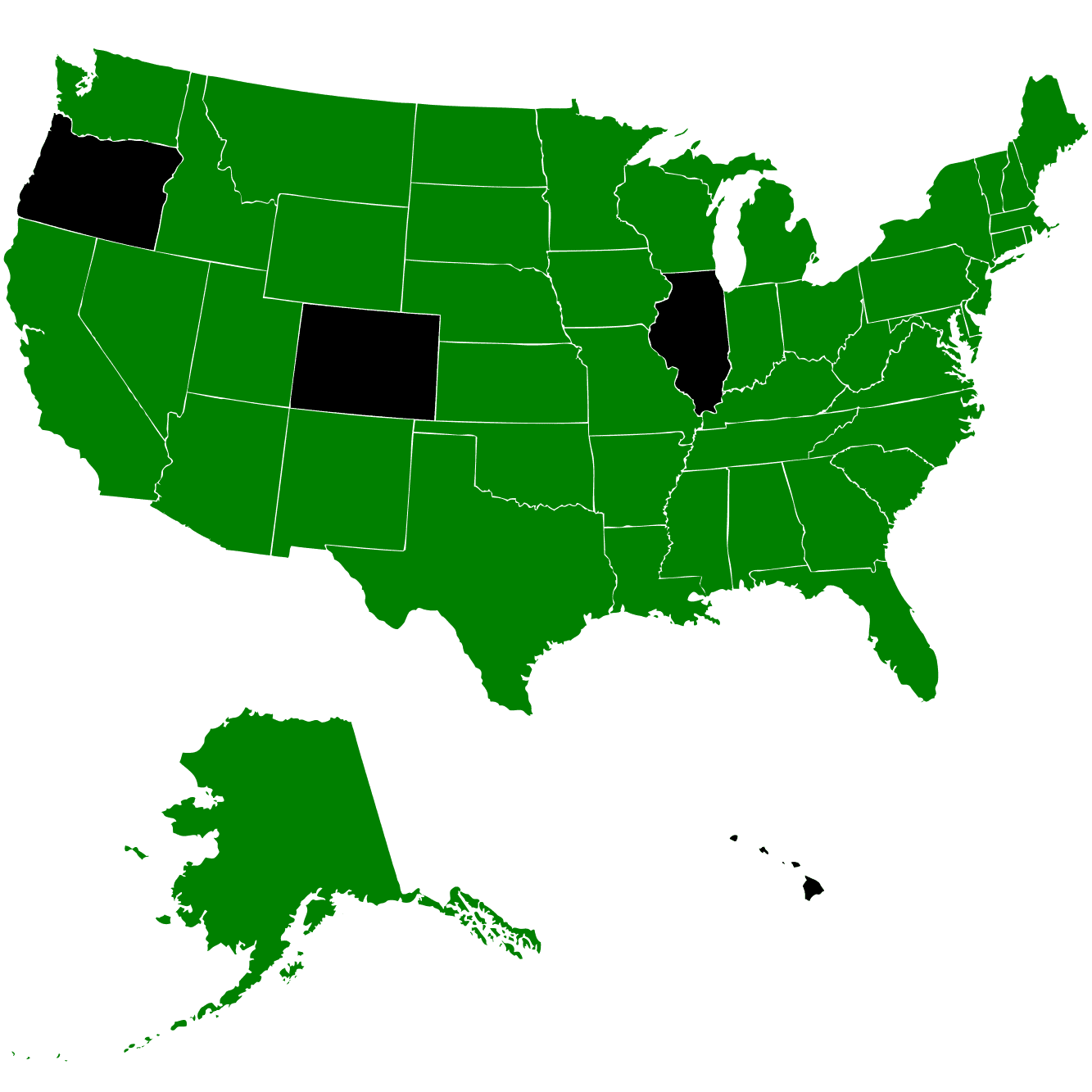
A Massachusetts LTC goes a long way in providing concealed carry coverage across the U.S. At the time of writing, a Massachusetts resident with an LTC can carry in roughly 35 states through a combination of reciprocity and constitutional or permitless carry policies. That number can be 36 for those with a Massachusetts LTC that was issued or renewed after August 1, 2024 because of Minnesota's recent recognition of newer Massachusetts licenses. Currently, it's possible for a Massachusetts resident with an LTC to carry a concealed firearm in a total of 46 states if they obtain all possible out-of-state permits mentioned in this guide. We will go over the permits needed to increase coverage, and a summary of each application process.
A common misconception is that there exists a singluar "multi-state license". Currently, this is not the case. Multi-state licensing refers to the process of obtaining permits from multiple states to increase your carry coverage. The key to an efficient multi-state licensing strategy is to target the state permits that grant you coverage in states that your Massachusetts LTC does not cover, while avoiding permits that do not add much practical value as a Massachusetts resident. For students attending our multi-state licensing class, and generally for most Massachusetts residents, that means focusing on permits from Arizona/Florida, Utah, Connecticut, and Pennsylvania, as these are the easier permits to obtain from the list of states in this guide. With these permits, a Massachusetts resident would be able to carry in 41 states. There are more state permits that are possible to obtain as a Massachusetts resident that would bring the number up to 46, but they do require more effort. We will touch on these as well.
Arizona CCW permit (or Florida CWL)
Arizona and Florida both allow permitless carry in-state for most adults who may lawfully possess firearms, so their permits are primarily useful because of the states that recognize them. Additionally, obtaining these permits may remove certain carry restrictions in their respective states. For a Massachusetts resident, either one of these permits will grant carry coverage for the same two additional states. Those states are New Mexico and Delaware. A Massachusetts LTC is not required to apply for either of these permits.
For students in our multi-state licensing class, we focus on the Arizona permit, which is also one of the simpler applications compared to the other permits mentioned in this guide. You can apply online through the Arizona DPS Permitium portal. Generally, you will need:
- A copy of drivers' license, state ID, or passport
- Proof of firearms training: Either a qualified certificate, OR a Massachusetts LTC
- If born outside US → Copy of US passport or certificate of naturalization
- Fingerprints - electronically via appointment booked through FieldPrint, OR two physical cards mailed to Arizona DPS
After submitting the online application, you should receive fingerprinting instructions and an application order number. If mailing physical fingerprint cards, the application order number must be included with the cards you mail to Arizona DPS.
For students taking our multi-state licensing class, we provide the training certificate, the two physical fingerprint cards, and a stamped envelope so that you leave the class ready to drop off the envelope in the mail after submitting the online application. This avoids having to make a separate appointment for electronic fingerprinting.
Utah CFP
Utah itself is a constitutional carry state, so the Utah Concealed Firearm Permit is primarily useful because it adds coverage for Washington and Delaware for Massachusetts residents. Additionally, a Utah CFP will remove certain carry restrictions in-state.
Utah requires a course taught by a Utah BCI certified instructor. The application must be received by Utah BCI within one year of the training date. Massachusetts residents do not need any prior carry permit to apply for the Utah CFP. Utah only requires a home state carry permit from applicants of states that have reciprocity with Utah. Massachusetts is not one of those states.
You can view Utah BCI's application information here. Generally, the Utah envelope you mail to Utah BCI should include:
- The original Utah application signed by the student and the instructor
- A photocopy of driver's license or state ID
- One physical fingerprint card
- A passport-style photo with your full name written on the back
- If born outside U.S. → Copy of US passport, naturalization certificate, or permanent resident card
- The non-resident application fee payable to Utah BCI
For students taking our multi-state licensing class, we provide the fingerprint card, the passport photo, ID photocopy, and a stamped envelope so that you leave the class ready to drop off the application in the mail.
Connecticut pistol permit
Connecticut is on this list because Connecticut does not recognize other states' carry permits. If you want to carry in Connecticut, you need a Connecticut State Pistol Permit. A Connecticut permit will also add coverage for Minnesota for Massachusetts residents whose LTC was issued before August 1, 2024.
Out-of-state residents apply directly through the Connecticut State Police Special Licensing and Firearms Unit. Start by emailing SLFU.OOS@ct.gov and requesting an out-of-state resident pistol permit application packet. You can also review Connecticut's state pistol permit page here.
Connecticut generally requires you to already have a permit or license to carry from another state. Not all state permits are accepted by CT, but for our students, the Massachusetts LTC, Arizona permit, or Utah permit may be used to apply. The packet also includes a Local Permit Verification Form that must be completed by the agency that issued the permit you are using to apply.
Connecticut packets are more involved than Arizona and Utah. Expect to gather the following:
- The completed Connecticut out-of-state application packet
- A copy of the permit you are using to qualify
- Forms that may need to be signed and notarized
- A passport-style photo attached to the required form, signed and notarized
- One completed fingerprint card
- The online fingerprint processing fee payment
- A check payable to the Treasurer, State of Connecticut
- Two certificates (including a training certificate) provided in a qualified firearms safety course
- Proof of citizenship, such as a birth certificate or U.S. passport
- Alien Registration card (if applicable)
- The Local Permit Verification Form completed by the issuing agency
Connecticut states that firearms training must have been completed within the past two years. For students taking our multi-state licensing class, we provide the two required certificates, passport photo, and physical fingerprint card. The remaining tasks for students will be to obtain one of the prior state permits, get certain forms notarized, and the permit verification form filled out by the issuing agency.
Pennsylvania permit
Pennsylvania does not recognize the Massachusetts LTC. If a Massachusetts resident wants to carry in Pennsylvania, they must apply for a Pennsylvania License to Carry Firearms. Most non-residents must have a concealed carry permit issued by their home state, so Massachusetts residents should wait until they receive their Massachusetts LTC before applying.
Pennsylvania is different from most of the other permits in this guide because you apply through a county sheriff, and you have to make at least one physical visit during the application process. We typically recommend applying through either Pike County, York County, or Berks County, because they all have online applications and typically only require one in-person visit. Pike County is one of the easiest to apply through and the closest recommended county when driving from Massachusetts. The only possible drawback to applying through Pike County is that any address changes may possibly require an in-person visit to the county sheriff's office. This needs to be confirmed. York County is another option for simplicity, and tends to have positive feedback from applicants. Another recommendation is to apply through Berks County, as it is the closest recommended county to Philadelphia International Airport, in case you intend to fly to PA to pick up the permit. County policies may change, so review the sheriff's page before applying.
Generally, you will need to provide:
- A copy of your Massachusetts LTC
- A copy of your driver's license or state ID
- The application fee
After approval, Pennsylvania licenses must be picked up in person. York County currently says approved licenses are held for 30 days. Pike County has typically required pickup within 45 days. Because these counties tend to issue permits quickly, we recommend only applying when you are ready to pick up the permit. Berks County may require scheduling an appointment to pick up the permit.
Other obtainable states
There are other state permits a Massachusetts resident may be able to obtain, but they are not part of our multi-state licensing class because they have additional requirements, such as qualifications, longer training, uniquely qualified instructors, or range conditions we cannot currently support in the same class session. The following states will only recognize their own permits:
California
California now has a non-resident CCW pathway, but it is a separate county-based process. You should have your Massachusetts LTC, own the firearm or firearms you want to list, and book a separate qualification appointment because California requires a live-fire qualification with each handgun you want to carry.
We have a separate step-by-step California guide here. If you are ready for the live-fire portion, you can view our California Non-Resident CCW Qualification Session.
New Jersey
New Jersey issues Concealed Carry Permits to out-of-state residents, but it has its own process and training standard. You need to already own the firearms you plan to carry, so as a Massachusetts resident you will need an LTC and list those handguns on the application. New Jersey requires applicants to complete the CCARE protocal qualification and use of force training and submit a PTC Safe Handling and Proficiency Certification. You must achieve a minimum 80% accuracy on the qualification course.
For more information about the New Jersey permit process, you can view the following resources:
- NJ State Police concealed carry permit page
- Out-of-state resident instructions document
- NJ application portal
If you want help with New Jersey, book a separate appointment with us. It cannot be handled as part of our standard multi-state class because the training requires you to already own the firearms you plan to carry.
Rhode Island
Rhode Island only honors Rhode Island permits, and it has two distinct paths to get one:
- Applying through a city or town's police department, which is effectively a shall-issue process, or,
- Applying directly to the Rhode Island Attorney General, which is a may-issue process.
Non-residents are recommended to use the local, shall-issue path, but only if they already hold a carry permit from their home state. As a Massachusetts resident you will need an LTC. Without a home-state permit, non-residents are limited to the discretionary AG path.
Regardless of which path you use, Rhode Island requires you to qualify by firing a score of 195 or better out of 300, shooting 30 rounds (three 10-shot strings) at 25 yards on an Army "L" target. The qualification must be certified within the past year by a qualified instructor.
Application requirements vary by city/town, but they generally include a fee, fingerprinting, passport-style photos, and/or reference letters. Permits are valid for four years.
We do not regularly offer this service because of the 25-yard range requirement. The primary range we operate from is limited to 15 yards. If you are interested in obtaining this permit, contact us and we may be able to connect you with an instructor who can conduct the qualification at a separate location.
Maryland
Maryland issues Wear and Carry Permits to non-residents, but the initial permit requires 16 hours of training by a Maryland Qualified Handgun Instructor.
We do not currently offer the initial 16 hour Maryland course. We can offer the shorter 8 hour renewal course on a case-by-case basis. Contact us if that is something you need.
You can learn more about the permit requirements and application process on the Maryland State Police Wear and Carry Permit page
New York
New York may be obtainable for non-residents when applying through New York City, but it requires its own application process and a course taught by a qualified New York instructor. The standard New York concealed carry training requirement is commonly described as 16 hours of classroom instruction plus 2 hours of live-fire training. We do not currently offer this course.
Non-obtainable states
The following states do not recognize the Massachusetts LTC and are not readily obtainable for Massachusetts residents trying to maximize carry coverage. In some cases the state does not issue to non-residents. In others, the state only issues to nearby residents or residents of certain states other than Massachusetts.
Illinois
Illinois only accepts non-resident concealed carry applications from residents of states that Illinois considers "substantially similar" in firearms licensing laws to Illinois. These states include Arkansas, Idaho, Mississippi, Nevada, Texas and Virginia. Massachusetts is not an eligible state, so Illinois does not currently issue concealed carry licenses to Massachusetts residents.
Hawaii
Hawaii's carry license statute currently requires the applicant to be a resident of Hawaii. Because of that residency requirement, Hawaii is not currently obtainable for Massachusetts residents.
Colorado
Colorado concealed handgun permits are issued to Colorado residents, with limited exception for active-duty military members stationed in Colorado. Colorado may recognize permits from certain states, but it also generally requires that permit holders of those states be residents of those states. The Massachusetts LTC is not recognized by Colorado, and a Massachusetts resident cannot gain reciprocity with Colorado by obtaining a non-resident permit from a state that Colorado does recognize.
Oregon
Oregon may allow sheriffs to issue concealed handgun licenses to residents of contiguous states who have a compelling business interest or other legitimate demonstrated need. Massachusetts is not a bordering state, so Oregon is not a realistic non-resident option for Massachusetts residents.
Conclusion
Carry permit reciprocity and coverage can change constantly. Before relying on any permit while traveling, please do your own due diligence by checking each state's laws, policies, and procedures. You may use a resources such as the USCCA Reciprocity Map.
It is also important to know when each permit expires, what each issuing state requires after an address change, and the carry restrictions that apply in any state where you plan to possess or carry a firearm.
The information above does not constitute legal advice and we make no claims regarding the accuracy of any information. We do our best to gather information from reliable third-party sources, but laws and regulations are subject to change and we are under no obligation to update the information provided. This material is simply provided for your convenience. Please do your due diligence in regards to legal matters. Please contact us if there are any inaccuracies present.